
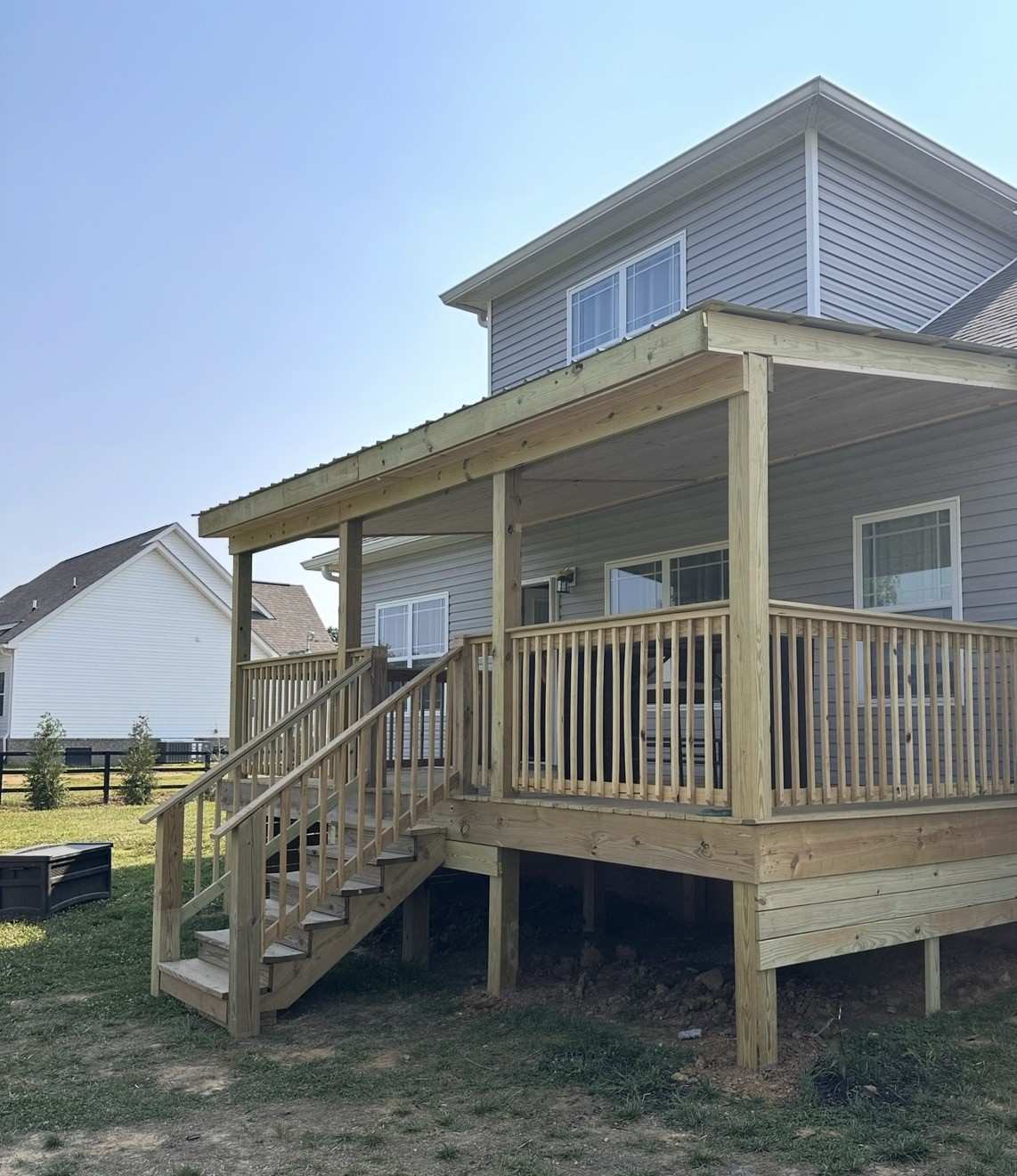
Why a price per square foot only gets you so far
Most people researching deck cost in Middle Tennessee start with a price per square foot. That figure is easy to find and hard to trust. It assumes a flat yard with soft digging and a plain rectangle a step or two off the ground. Plenty of yards around here look nothing like that. Many lots slope away from the house, and some have limestone a short way under the grass.
We are leaving dollar figures off this page, because a number without your yard behind it would mislead you. Instead, here are the decisions that push a deck budget up or down, so a bid makes sense when you read it. For a broader look at deck projects, see our deck building page.
Size and shape of the deck
Size is the obvious driver, since a bigger footprint needs more footings and more framing. Cost does not climb in a straight line, though. Some expenses come with every job regardless of size, like the permit and the stairs down to the yard. Spread over a larger deck, those fixed pieces often bring the price per square foot down a little.
Shape matters too. A plain rectangle is the most efficient thing to frame. Each angle or level change adds cutting and framing time. Diagonal boards or a border of boards around the edge create more waste and usually need extra support underneath. None of that means giving up a design you like. It just helps to know which parts of the drawing drive the number.
Height off the ground changes the whole job
A deck a step above the grass is a different project from one off a second floor. Height brings longer posts and more bracing to keep the frame from swaying. Past a certain height, railings are required along the open sides, and the stairs get longer. Your local codes office can tell you where that railing line falls for your address.
Rolling ground is common across Middle Tennessee, and many houses on sloped lots have a walkout basement. That usually puts the back door well above the yard, so a tall deck may be the only practical option. If the budget is tight, a small upper landing with stairs down to a patio can cost less than one big raised platform. A tall deck leans on its bracing and on its connection to the house to stay stiff, so look closely at how each bid handles both.
Clay, limestone, and what happens at the footings
Every deck sits on footings, and footings are where yards in this region tend to surprise people. In many parts of the Nashville Basin, limestone sits close to the surface. A crew digging footing holes may hit solid rock after a short dig and need a rock drill or a jackhammer to reach the depth the plan calls for. Sometimes the post layout can shift instead, if the codes office approves the change. Either way it adds labor, and nobody knows for sure until the first holes go in.
Where rock is not close to the surface, heavy clay often is. Clay swells when it soaks up water and shrinks as it dries, and that movement can shift a footing that is too shallow or too small. Your local building department sets the footing rules, and in many places an inspector checks the holes before concrete goes in. Before anyone digs, someone has to contact Tennessee 811 so the utility companies can mark their buried lines. State law requires it, and the call is free.
Water matters too. Downspouts that empty under a deck keep the soil soft around the posts, and moving one is cheap compared with fixing a sunken footing. At the house, flashing over the ledger board keeps rain out of the wall behind the deck. A ledger without good flashing is a common cause of hidden rot in the deck frame and the house framing behind it.
Decking material in Tennessee heat and humidity
Under most decks here, the frame is pressure treated pine, so the real material choice is the surface you walk on and the railing. Treated pine decking costs the least up front. It often arrives damp from treatment and shrinks as it dries. In our summer sun and humidity it tends to crack along the grain and cup unless it gets cleaned and sealed on a regular schedule. That upkeep is a real cost, paid in weekends or in hiring someone.
Composite and PVC boards cost more at the start and ask less of you afterward. You skip the staining, but you still wash them, because mildew grows on almost any surface in a shaded, humid yard. Those boards also get hot in afternoon sun, and darker colors run hotter. Each composite product lists its own joist spacing, and some call for joists closer together than a wood deck would use, especially with diagonal boards. More joists means more framing cost, which a comparison of board prices will miss. Our guide to wood vs composite decking covers that tradeoff.
Hardware is a quieter line item. The chemicals in treated lumber corrode plain steel, so joist hangers and screws need a coating rated for contact with treated wood. Stainless hardware costs more. Ask each builder what hardware they plan to use so the bids match.
Railings and stairs add up faster than people expect
Railing is often one of the largest single items on a deck bid. It runs along every open edge, and a tall deck on a slope has a lot of open edge. Wood railing with wood balusters is usually the least expensive option. Metal balusters in a wood frame cost more, and aluminum or cable systems usually cost more again. If you live in a subdivision with an HOA, the style may also need to match what the architectural committee allows.
Stair cost depends on how many flights you need and how wide they are. A tall deck may need a landing partway down, and each extra flight brings its own footings and handrails. When you are weighing two designs, count the stairs in each one. The design with fewer flights can turn out to be the better value, even with more square footage up top.
Permits and HOA approval
Many cities and counties in Middle Tennessee require a building permit for a new deck, especially one attached to the house or built well off the ground. Rules change from one codes office to the next, and some rural counties handle residential permits differently than the cities do. The permit fee itself is usually a small part of the total. Drawings and waiting on inspections add more. Our guide on deck permits in Tennessee explains how to find out what your address needs.
HOA neighborhoods are common in the fast growing parts of the region, especially newer subdivisions. Many associations want to approve a deck before work starts, and some limit the materials and colors you can use. A rule that requires composite boards in a set color takes treated pine off the table, which can move the price a good deal. Read your covenants before you collect bids and share them with every builder, so each bid covers the same approved design.
Site access and tearing out an old deck
Getting materials to the backyard can change the price. If the only way into the backyard is a narrow side yard, lumber gets carried by hand, and a machine for drilling rock may not fit. Townhomes with shared walls often have the same problem. On rural acreage the path is usually open, but a septic field can limit where heavy equipment should drive. Mention any of these when you ask for a bid.
Replacing an old deck adds demolition and hauling. Treated lumber should not be burned, so the old boards and framing get loaded up and taken away, which means labor plus disposal fees. The bigger unknown is what the old deck was hiding. Rot in the ledger board, or in the house framing behind it, often shows up only once the boards come off. Old footings may be too small or too shallow to reuse. A careful bid says how those finds will be handled.
How to compare deck bids side by side
Once you have a few bids, make sure they describe the same deck. A single total tells you very little, so ask each builder to break out what is included. Start with the footings, since that is where rock and clay show up. After that, compare the framing and hardware, then the decking and railing. Check whether the permit and the tear out are included or listed as extra. When one bid is far below the others, it is often leaving something out or assuming an easier yard.
Good bids also say what happens when something unexpected turns up. Ask how rock is priced if the footing holes hit it, and how rotten framing at the house will be handled. Lumber prices move, so find out how long the number holds. A payment schedule tied to progress is safer than a large payment up front. Tennessee requires a state contractor license above a certain job size, and some counties add a home improvement license for smaller jobs. Get the license number and look it up with the state, along with proof of insurance.
Permit offices and HOA rules differ from town to town, so where you live shapes the bid too. You can check whether your town is listed on our service areas page. When you want a number built on your own yard, the estimate form on this page is the place to start.
Quick answers
Why won't a deck builder give me a price over the phone?
Most of what moves the price only shows up in person. How high the back door sits and how the yard slopes both change the job, and so does the path a crew would use to get there. Rock under the surface cannot be seen at all until someone digs. A phone quote would either be padded to cover those unknowns or too low to hold. Seeing the yard first and getting a written, itemized bid is worth the wait.
Does hitting rock always raise the cost of a deck?
Not always, but it often adds labor. Some holes clear the rock, and some plans can shift a post to miss a rock ledge. When a hole does hit solid limestone, the crew needs extra time and equipment to get through it. Neighbors who built a deck or a fence on your street may know what is down there, which is a useful clue. Since nobody knows for sure until digging starts, ask each builder how rock will be priced before you sign.
Is it cheaper to put new boards on my old deck frame?
Sometimes. If the frame underneath is sound and was built well, new decking and railing on the old structure can save real money. The catch is that the frame is often the part that has aged the most, especially where it attaches to the house. If you want composite boards, the old joists may also be spaced too far apart for them. Have someone check the ledger connection and probe the joists for soft spots before you decide.