
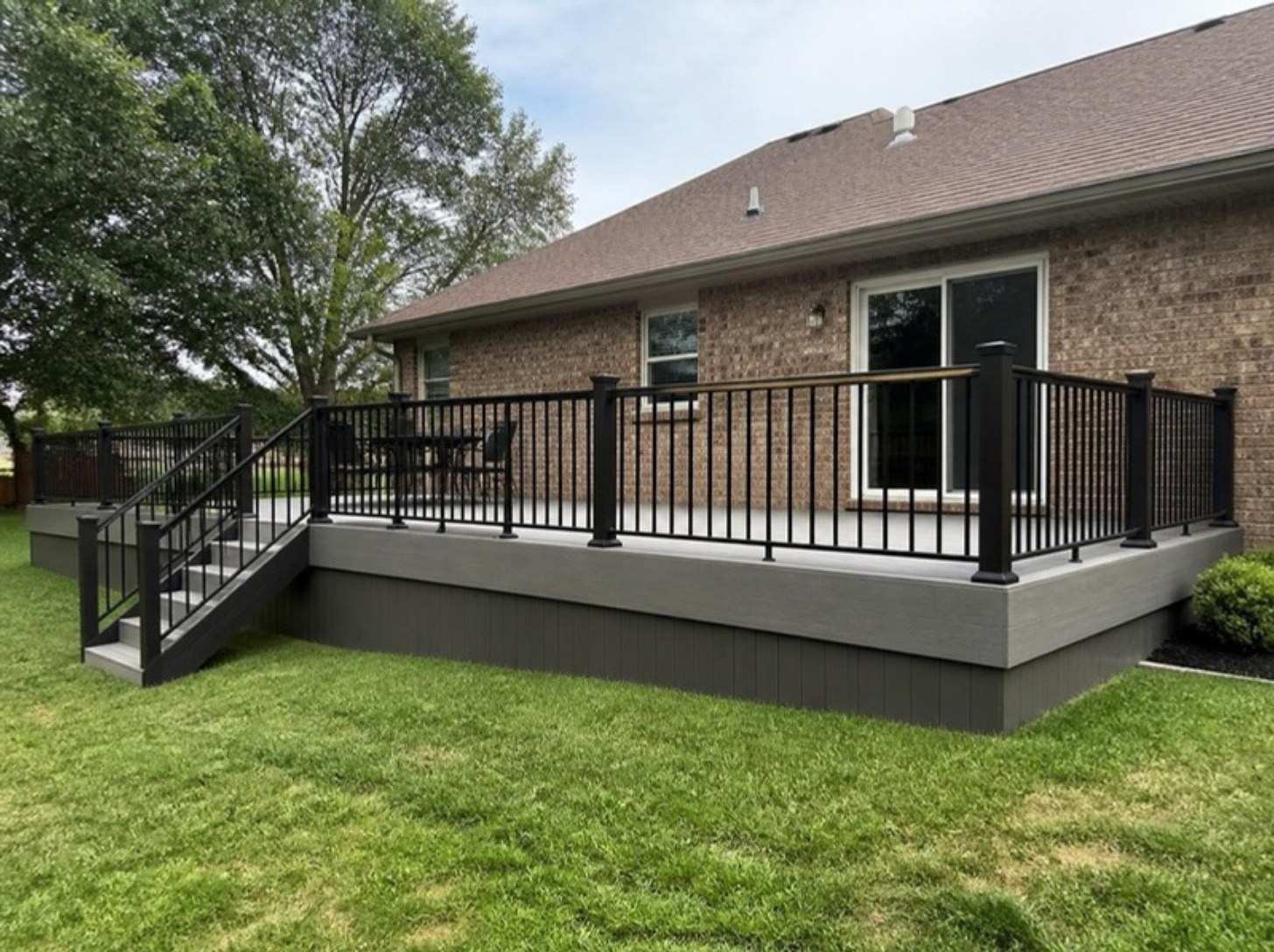
The short answer for Tennessee backyards
Wood vs composite decking is less about which lasts and more about the work each one asks of you later, since both can hold up in Tennessee when the deck is built right. It also comes down to how each one feels underfoot in July. Pressure treated pine usually costs the least at the start and needs the most care. Cedar is real wood that stays flatter, though it is soft and still needs attention. Composite skips the staining but usually costs the most up front, and it runs hotter in direct sun.
For most people the choice turns on how much sun hits the spot and how much time they want to give to upkeep. How long you plan to stay in the house matters as well. The extra cost of composite comes back slowly, if at all, through skipped stain days, so a short stay rarely pays it off. For size and layout, the deck building page covers the rest of the planning.
Three kinds of boards on one kind of frame
Pressure treated pine is the lumber stacked at most building supply yards around here. In the South it is usually southern yellow pine, treated with preservative under pressure so it resists rot and termites. Cedar heartwood has natural oils that slow decay, and the boards are lighter and less likely to twist than pine. Composite boards blend wood fiber and plastic. Many sold now are capped, meaning a hard plastic shell covers the core to help keep out stains and moisture.
Under most decks, the posts and joists are pressure treated wood, even when the boards on top are cedar or composite. Composite boards do nothing to make that frame last longer. They can even outlive the wood holding them up if the frame was built carelessly or sits in standing water. So this choice is about what you walk on and look at. The footings and framing decide how long the deck stays safe, whichever boards you pick.
Summer sun and how hot the boards get
Tennessee summers are hot and humid, and a deck facing west or south with no trees nearby takes hard sun through the afternoon. That is where composite shows its biggest weakness. The boards soak up heat and can get too hot for bare feet, and darker colors get the hottest. Wood warms up too, but it usually stays more comfortable to stand on. If kids will be out there barefoot, or a dog likes to lie in the sun, give that real weight.
Sun also changes the color of every board. Unstained pine and cedar turn gray over time, and the surface starts to check, meaning small cracks open along the grain as the wood gets wet and dries out again and again. Stain slows that down. Many composite boards lighten a little in their first months outdoors and then hold steady, and capped boards keep their color far better than uncapped ones. Lighter colors also stay cooler, so for a deck in full sun, look at the light end of the color chart first.
Humidity and mildew on shaded decks
The other half of Tennessee weather is humidity. A deck under big hardwoods, or on the north side of the house, can stay damp long after a summer storm. Wood in that spot can grow mildew and green algae, and boards that never fully dry can start to soften at the ends and around the screws. Treatment does not always reach the center of a board, so careful builders brush preservative on cut ends. Each spring, pollen leaves a yellow film that holds moisture and gives mildew something to feed on.
Composite boards do not rot the way wood does, but they are not mildew proof. Mildew grows on the pollen and grime sitting on top, and a shady composite deck can show dark spots by late summer. The fix is usually a soft brush and a cleaner the board maker approves. Read the care guide before using bleach or a pressure washer, since some makers warn against one or both. A cleaned composite deck usually looks close to how it did, while a pine board that stayed wet too long may need sanding and fresh stain, or replacing.
What upkeep looks like over the years
New pressure treated lumber often arrives still wet from treatment. It shrinks as it dries, and some boards may cup or twist even when they are fastened well. Stain goes on once the wood has dried, not the week the deck is finished. To tell when, sprinkle a little water on the boards. If it beads up, give it more time. Water that soaks right in means the wood is ready. After that, plan on a cleaning each spring and fresh stain every few years, sooner on a deck in full sun.
Cedar needs a similar routine. Owners who want to keep the reddish brown color stain or seal it every so often, while others let it go gray on purpose, which is fine as long as it gets cleaned and dries out between rains. Composite trades stain days for washing. Plan on a scrub in spring and fall, plus sweeping off leaves and moving planters now and then so they do not trap water against the boards. Our deck maintenance guide goes through the seasons for both kinds of deck.
How each material looks as it ages
Up close, stained cedar has a grain and color that composite can imitate but not quite match. Treated pine takes stain well once it dries and can look good for years with care, though you will see knots and the odd board that twists. Composite gives you even color with no splinters, and many newer boards have color streaks that look more like wood than the flat brown boards of years ago. Some people still see plastic, so look at a finished composite deck in person before you decide.
Think about repairs too. A limb that drops in a spring storm can crack a few boards. With wood, you replace them, and once the new boards dry and take the next coat of stain they come close to matching. Composite is harder to match, since a new board may look a shade different beside weathered ones and colors are sometimes discontinued. Ask whoever builds the deck to leave a few spare boards from the same order. Scratches follow the same pattern. You can sand a gouge out of pine or cedar, but a deep scratch through a composite cap stays.
Clay and rock matter more to the frame than the boards
Much of Middle Tennessee sits on heavy clay, and in many neighborhoods limestone lies close to the surface. Digging through rock or setting footings in clay takes the same work whatever boards go on top. When you compare prices for two materials, make sure the footings and frame match in each quote, apart from any extra joists the composite boards call for. That way the difference you see comes from the boards and not from a change in the digging.
Clay also holds water. After a heavy storm, the ground under a low deck can stay soggy for a long while, and a deck built close to it gets little airflow. Wood boards there stay damp longer and wear out sooner. Composite makers call for open space under their boards too, and their instructions spell out how much. Keep the sides of a low deck open enough to breathe, and make sure water runs away from the posts. One more detail: treated lumber corrodes plain steel, so screws and joist hangers need to be rated for it.
HOA neighborhoods and permits
Many newer subdivisions in Middle Tennessee have an HOA with an architectural review step. Some review boards care about material and color as much as size and placement. One may require a stain from an approved list, while another wants to see the composite color before you order. Get approval in writing before buying materials, and name the specific board and color in your submission. Our guide to getting HOA approval for a deck covers how to put that request together.
Picking composite rarely changes whether you need a permit. Attached and raised decks often need one either way, and the rules differ from one city or county to the next. What composite can change is the framing. Some composite boards call for joists set closer together than wood boards need, especially on a diagonal pattern, and inspectors may check that the frame follows the board maker's instructions. Call your city or county codes office before you settle on a material and ask what they will want to see.
Choosing the right boards for your yard
Treated pine makes sense for a large deck on a careful budget, or for a homeowner who does not mind a stain day every few years. Cedar suits a smaller deck, where the price gap matters less, and anyone who wants real wood that tends to stay flat. Dog claws mark it more easily, since it is softer than pine. Composite fits households that plan to stay put and would rather not stain, as long as the deck gets some shade or the boards are a light color. Above all, pick the board whose upkeep you will actually do.
To see real numbers, ask for two quotes on the same design, one with wood boards and one with composite, with everything else the same. The gap between them is the true extra cost of composite. Set it against what you would spend on cleaner and stain, plus the weekends it takes, over the years you expect to live there. When you are ready to price your own deck, use the estimate form below and mention which boards you are leaning toward. To check whether we work near you, see the service area page.
Quick answers
Is composite decking worth the extra cost in Tennessee?
It depends on how long you will stay and how much sun the deck gets. Composite costs more up front and saves you the staining that wood needs every few years. If you plan to be in the house a long time and dislike stain days, it can be worth it. If money is tight or you may move within a few years, pressure treated pine is usually the practical call. Ask for quotes on both to see the real gap for your yard.
Does composite decking get too hot to walk on?
It can. On a clear summer afternoon, composite in full sun can get uncomfortable for bare feet, and dark colors get the hottest. Lighter colors help, and so does afternoon shade from a tree or the house. You can test this yourself. Lay a sample of each board where the deck will go, come back after a couple of sunny hours, and put your palm or a bare foot on each one.
Can composite boards go on my old wood deck frame?
Sometimes, but only after the frame is checked. Composite boards can last a long time, so putting them on joists near the end of their life wastes money. Look for soft wood at the ledger board where the deck meets the house, and around the posts and joist tops. Some composite boards also need joists spaced closer than an older wood deck has, which can mean adding framing. A builder can tell you whether the frame is worth keeping.