
Why a slope changes the plan
Building a fence on a slope starts with one choice: step the panels down the hill or tilt them to follow it. On flat ground, posts go in at even spacing and every panel hangs the same way. On a hill, that choice decides how big the gaps at the bottom get and how long each post has to be. The slope also limits where a gate can swing, and after a hard rain, water runs along or against the fence line.
Sloped yards are common across Middle Tennessee. Brentwood and other parts of Williamson County have wooded hills where backyards fall away from the house. Lots on Old Hickory Lake often slope toward the water, and Cookeville sits on the Highland Rim in rugged, hilly country west of the Cumberland Plateau. Even in flatter subdivisions, many back lots tilt toward a drainage swale or a creek.
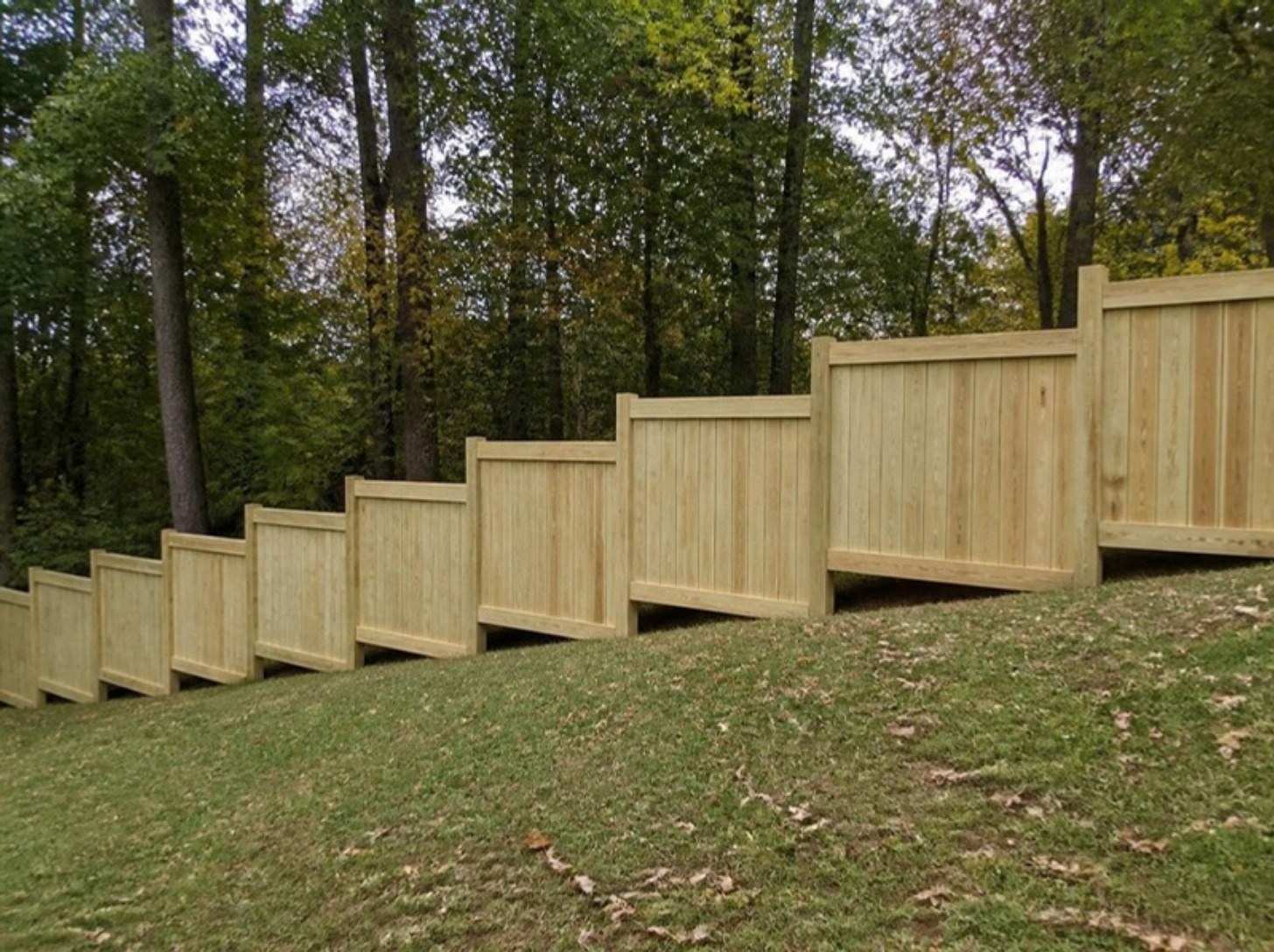
Stepped fences keep each panel level
A stepped fence keeps every section level and drops it down at each post, like a staircase seen from the side. Each section has a level top, which many people find tidy from the street. It suits prebuilt panels, which are made square and meant to hang level. Most vinyl privacy panels go in this way.
The tradeoff is the gap. Because each panel stays level while the ground falls away, a triangle of open space forms under its downhill end. Those triangles stay small on a gentle grade. On steep ground they can grow big enough for a small dog to squeeze under. Steeper ground also makes each step taller, which some homeowners find choppy to look at.
Racked fences follow the grade
A racked fence tilts with the hill. The rails run parallel to the ground while the posts and pickets stay plumb. From the side, the top of the fence follows the slope, and the bottom stays close to the dirt the whole way down, so there are no stair step gaps to fill. Racking works best when pickets go up one board at a time on site, which is how many wood privacy fences are built.
Racking has limits. Many prebuilt wood panels rack only a little, and most vinyl privacy panels are built rigid. A racked fence also copies every bump in the ground. That looks natural on a smooth, even slope, but on lumpy ground the top line can wander in a way some people like less than steps. A common answer is to rack the long, steady stretches and add a single step where the grade changes sharply.
To see which suits your yard, drive a stake at each end of the line and pull a string tight between them just above the ground. Walk the line and watch the space under the string. An even space means racking will look clean. When it grows and shrinks, stepping or a mix of the two usually looks better.
Closing the gaps under a sloped fence
Every fence on uneven ground ends up with some gap at the bottom. On a stepped fence, the usual fix is a bottom board, often called a rot board or kickboard, cut to follow the ground under each section. Use lumber rated for ground contact. Wood that sits against damp soil rots, and our humid summers and rainy stretches give it plenty of chances.
Other fixes each come with a catch. Fill dirt packed into the gaps looks tidy at first, but in clay it often settles or washes out after a few storms. Landscape stone or block lasts longer, though packed tight it can hold water against the fence. Some owners leave small gaps on purpose so water and air can move through. That works when the fence is there for privacy and not for keeping a pet in.
Keeping a dog in on a hill
Dogs find the low spots. On a sloped line, the usual weak point is the downhill end of each stepped panel. A gate hung over uneven ground is another, and so is any groove where rain has washed soil out from under the bottom board. Clay gone soft after a storm is easy digging, and a dog that finds one route tends to keep working it.
Height works differently on a slope too. With a stepped fence, the fence stands shortest above the ground at the uphill end of each panel, and a dog that jumps will find that spot. A racked fence keeps the same height along the whole run. For diggers, wire mesh fastened to the bottom and laid flat or buried along the inside edge often stops tunneling while still letting water through. Our guide to the best fence for dogs covers jumping and digging in more detail.
Setting posts in hillside clay and rock
Slope changes post spacing. On a stepped fence, the drop at each post equals how far the ground falls across one section, so steep runs often get shorter sections to keep the steps and gaps small. Those posts also need extra length, since each has to reach the top of the higher panel and still go deep into the ground. On a racked fence, spacing can usually stay closer to normal, with the rails cut at an angle where they meet the posts. Either way, posts should stand plumb and not tilt with the hill.
Measure along the ground, not from the plat. Your survey or plat shows flat distance, and a fence that climbs a hill covers more than that. On steep ground the difference adds boards and posts, so ask each installer how they measured when you compare estimates.
Then there is what sits under the grass. Limestone is close to the surface in much of Middle Tennessee, including large parts of Rutherford and Wilson counties. When a post hole hits rock, the installer may drill into it or shift the post, which changes the sections around it. Clay brings a different problem. It drains slowly, so water can sit around a post after a storm, and some clay swells when wet and shrinks as it dries. Concrete shaped at the top to shed water helps. Ask your installer how deep they plan to set posts in your soil, and why.
Drainage and storms on the downhill side
Water runs downhill, and a fence built across a slope sits in its path. Open gaps at the bottom let runoff pass under. A solid bottom of kickboards or stone can act like a small dam, so water pools on the uphill side and keeps the lower boards wet. Leaves and mulch pile up there too.
Check where water goes now before you set the fence line. Many subdivisions have a drainage swale or easement along back or side lot lines, and a fence across it can block the flow for you and your neighbors. Your plat may show the easement, and your HOA or city can tell you whether a fence is allowed there.
Storms bring wind as well as rain. A solid privacy fence catches wind like a sail, and one on a hilltop or open slope takes more of it than the same fence in a sheltered low spot. Spring and summer thunderstorms often bring strong gusts here, so posts at the top of a rise and at the ends of long runs need a solid set. On an exposed ridge, a shadowbox style lets some air pass between the boards.
Where the gate goes on a slope
Put the gate on the flattest stretch of the line if you can. If the ground rises where a gate swings, the bottom drags, and hanging it higher leaves a wedge of open space underneath. When a gate has to sit on a slope, swinging it toward lower ground usually gives the most clearance. Another option is to level the ground under the swing and set a small pad of gravel or pavers there.
Think about what has to pass through it. Pushing a mower or a loaded wheelbarrow up a steep gate path is hard work, so a gate near the top or bottom of the slope may be easier to live with than one halfway down. The hinge post carries the full weight of the gate, and in soft clay it needs an especially solid set so the gate does not sag over time. Self closing hinges and a good latch help when the gate is what keeps your dog in.
Check HOA rules and codes before anyone digs
Many neighborhoods in Middle Tennessee have an HOA that reviews fences before they go up. Some spell out style and material, and others set height limits or say which side faces the neighbors. On a slope, ask how they measure height. A stepped fence stands taller above the ground at the downhill end of each panel than at the uphill end, so the answer can decide whether your plan fits. Get approval in writing before ordering materials. Our guide to HOA approval for a fence or deck walks through the process.
City and county rules vary across the region. Call your city or county codes office to ask whether your fence needs a permit and how they measure height on sloped ground. Confirm where your property line runs before the layout is set. Then call 811 before any digging so public utility lines get marked. Private lines, like power to a shed or sprinkler pipe, usually are not, so locate those yourself.
A sloped yard is easier to plan with someone standing on it. When you get an estimate, ask the installer to walk the line with you and show where steps or racking would go. You can compare styles on our fence installation page and check the service areas page for your town.
Quick answers
Does a fence on a slope cost more than one on flat ground?
Often it does, but how much depends on your yard. Steeper ground usually means more posts and longer ones, plus extra cutting and boards or mesh to close gaps. Rock in the post holes adds time. A gentle slope may add very little. The only way to know is to have an installer walk the actual line and price it, then ask whether gap boards or mesh are included so you compare the same fence.
Should we level the ground before the fence goes in?
Sometimes a little shaping helps. Knocking down a hump or filling a dip along the fence line lets the bottom sit closer to the ground. Big grading jobs are different. Moving a lot of soil changes where water goes, and new fill in clay often settles unevenly. Some HOAs and cities want to review grading that sends water toward a neighbor, so ask before moving much dirt near a property line.
Can vinyl or metal fence panels go on a hill?
Yes, though usually as a stepped fence. Most vinyl privacy panels are rigid and hang level, so they drop at each post. Some metal panels, including many aluminum styles, can rack to follow a gentle grade, but each product has its own limit. On steep or rolling ground, wood built one board at a time is often the most flexible choice. Check the install instructions for the exact product before you commit.