
Start with the view you want to block
Most people comparing privacy fence options start with a photo of a style they like. A better starting point is the view you want gone. Stand on the patio at the time of day you use it most and look around. It might be a neighbor's back door, the side street, or a window that looks down into the yard. Each has a different best answer, and the last one is not really a fence problem.
A fence at a normal residential height blocks eye level views from the ground. It does very little against a two story house next door or a raised deck on a sloped lot. In those spots, a pergola over the patio or a row of evergreens may do more than any board pattern. Knowing which problem you have keeps you from paying for privacy where you do not need it.
Board on board gives the most complete screen
Board on board uses two layers of pickets. The first layer goes up with gaps between boards, and the second layer covers those gaps with some overlap. You get a solid wall of wood with no sight lines through it, even after the boards dry out. That matters here. Pressure treated pine is often installed while still wet, and it shrinks as it dries. On a fence where pickets simply butt together, that opens thin gaps. The overlap hides them.
The tradeoffs are weight and material. You buy more boards per section, so it usually costs more than a single layer fence, and the extra weight puts more load on posts and gates. From the back, board on board usually shows the posts and rails, so decide early who gets the smooth side. Tightly overlapped boards can also hold moisture between them after a rain. A good finish helps, and so does keeping the pickets up off the dirt.
Shadowbox looks the same from both sides
A shadowbox fence alternates pickets on opposite sides of the rails, offset so they overlap a little. Straight on, it reads as a solid fence. At an angle you can catch slices of light and movement between the boards, and how much depends on the overlap. Ask to see a built example from an angle before you commit. A photo taken head on tells you little.
People usually pick shadowbox because it looks finished from both yards, which heads off any debate over the good side. Some HOAs may prefer it for that reason. Air also moves through the offset gaps, so the boards dry faster after rain and the fence catches a little less wind. That airflow is real but modest. It does not replace deep, well set posts.
One warning about names. Crews and lumber yards use these terms loosely. Some call the alternating style board on board, and others use shadowbox for any fence with two layers. Before you sign, ask for a drawing that shows which side of the rails each layer goes on. Fixing a drawing costs far less than rebuilding a section.
Horizontal slat fences and how they age here
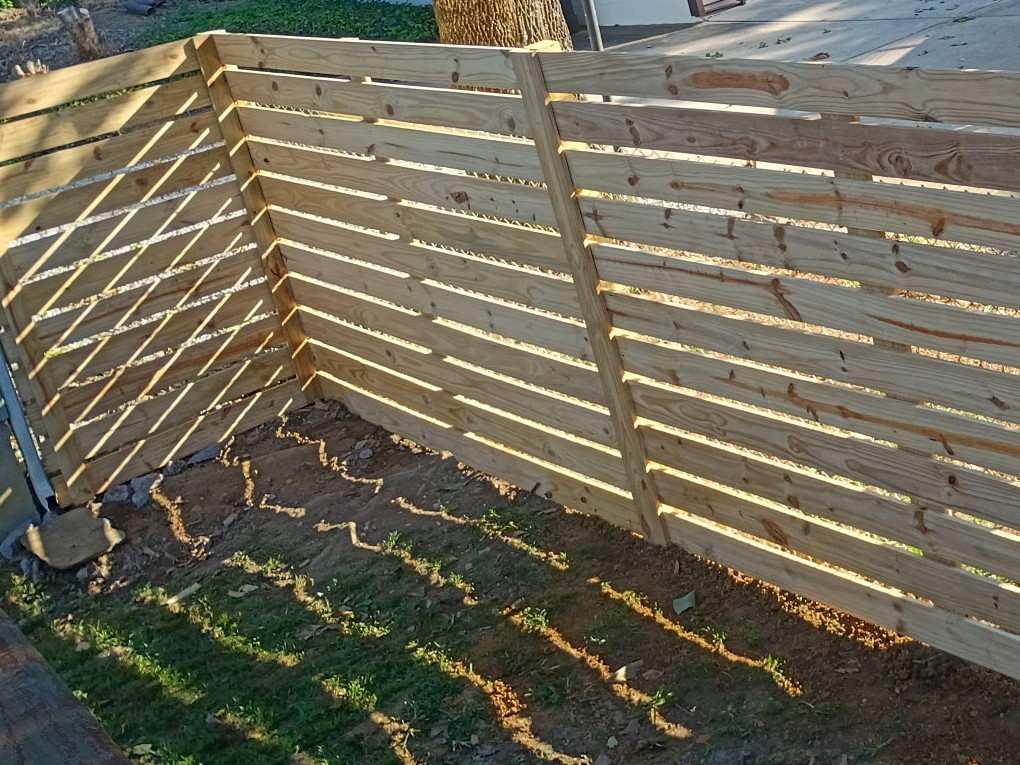
Horizontal boards give a clean, modern look that fits many newer houses. Privacy depends on the spacing. Butt the boards tight and you get a solid screen. Leave a gap and you get a partial screen that lets light and breeze through. A narrow gap can look nearly solid in daylight, yet a lit patio next door shows through it after dark. Decide on spacing in the yard with sample boards, not from a picture.
Horizontal slats ask more of the framing. A long board between posts can sag or bow over time, so posts often go closer together or the design adds a center support. Wood also cups as it soaks up humidity and then bakes in the sun, and on a horizontal fence that cupping shows along the whole run. The flat top edge of each board can also catch water and leaves. A cap board on top helps, and so does staying ahead of the finish.
From the back, a horizontal fence usually shows its posts and supports unless the design adds slats to both faces, which adds cost. Some HOA guidelines do not allow horizontal fences, so check yours before you settle on the look. This style often prices above a basic vertical fence, since it usually takes more labor.
Vinyl panels in Tennessee weather
Vinyl privacy fence panels are usually solid, with boards that lock together, so they block the view completely. They look the same from both sides and do not rot. Never staining again is the main appeal. Upfront cost usually runs higher than a basic pressure treated pine fence, so the math depends on how long you plan to stay.
Middle Tennessee weather still tests vinyl. Shaded runs on the north side of a house can grow a green film of mildew or algae in humid months, which washes off but comes back. Vinyl expands in summer heat and turns brittle in hard cold, so a knock that would bounce off in July can crack a board in January. Solid panels also take the full force of the wind, so ask how the posts are reinforced.
Repairs are the other downside. A broken wood board can be matched at almost any lumber yard. Vinyl parts usually need to match the original maker and color, which can be harder to find years later. If you choose vinyl, write down the product line and keep a spare board in the garage. The color is built into vinyl when it is made, so pick one you can live with for good.
Taller sections and toppers, and who sets the limits
Sometimes one stretch of fence needs more height than the rest, often where a neighbor's patio sits higher than yours. Two common fixes are a taller solid section in that one spot and a lattice or slat topper along the top. A topper adds height while letting light and air through. On a sloped lot, the way the fence steps down the grade changes how tall it reads, which our guide to fencing a sloped yard covers.
Before you plan extra height, find out what is allowed. There is no one fence height rule for all of Tennessee. Cities and counties set their own limits, usually through zoning, and many treat backyards differently from front yards and corner lots. Some places require a permit for any fence, and others only for taller ones. Near driveways and street corners, some towns limit height so drivers can see. Call the codes or planning office for your address and ask what applies, including whether a topper counts.
HOA rules sit on top of city rules, and they are often stricter. Many subdivisions around Nashville and its suburbs have written rules on fence height and style, sometimes down to the stain color. Get the current architectural guidelines from your HOA, submit your plan in writing, and wait for written approval before anyone digs. Our guide to HOA approval for a fence or deck walks through that process.
Why posts matter more than the picket pattern
A privacy fence acts much like a solid wall, and a wall catches wind. Spring and summer storms across Middle Tennessee can bring strong straight line winds, and a long run of solid fence takes that force at the posts. When a privacy fence leans or falls after a storm, the cause is usually the posts, not the boards. They were set too shallow or too far apart, or in ground that could not hold them.
The ground here makes that harder. Many yards in the region sit on clay that can turn soft after a long stretch of rain and shrink back during a dry spell. Posts set in concrete do better when the top of the footing is shaped to shed water. Ask how the crew finishes that top and how they handle drainage at the low end of the yard.
Then there is rock. Limestone sits close to the surface in a lot of Middle Tennessee, and an auger can hit it a short way down. Rock can be drilled, but that takes more time and different equipment, and you often cannot tell where it is until digging starts. Ask how an estimate handles rock before you sign. Before any hole is dug, someone should call 811 so buried utility lines get marked.
Which side faces out, and how to choose
On single sided styles, one face shows smooth pickets and the other shows posts and rails. Common practice and many HOA rules put the finished side toward the neighbors and the street. If you want the smooth side facing your own patio, check your HOA rules and your city before you assume you can. Shadowbox and most vinyl sidestep the question because both faces look alike.
To narrow it down, board on board is hard to beat when you want no gaps at all. Shadowbox makes sense along a long shared line. Horizontal slats suit a modern house if you will keep up with the finish. Vinyl fits people who never want to stain again, provided the HOA allows it. Wood species matters as much as style, and our comparison of cedar and pressure treated pine covers that choice.
When you are ready to price a fence, walk the line first and note the low spots, the big trees, and where the gates should go. Then send the details through the estimate form. You can also read our fences page and check the service area list for your town.
Quick answers
How tall can a privacy fence be in Middle Tennessee?
There is no single answer for the whole region. Each city or county sets its own height limits, often with different rules for backyards than for front yards and corner lots. An HOA can set a lower limit on top of that. Call the codes or planning office for your address, then read your HOA guidelines. Get both answers before you order materials, since cutting a finished fence down is far harder than planning it right.
Does a shadowbox fence give enough privacy?
For most backyards, yes. Straight on, a shadowbox fence looks solid. Standing at an angle close to the fence, you can see slivers through the offset boards, and at night a lit patio next door will show through in thin lines. More overlap between boards cuts that down. When you want zero gaps from any angle, board on board is the better choice.
Is vinyl or wood better for a privacy fence in Tennessee humidity?
Neither is a clear winner in humid weather. Wood takes on moisture and moves with the seasons, so it needs a finish to slow graying and mildew. Vinyl does not absorb water or rot, though shaded sections can grow a green film that needs washing. Up front it usually costs more, then asks less of you later. Wood is cheaper to start and easy to repair one board at a time. Your HOA rules and the upkeep you will really do should decide it.