
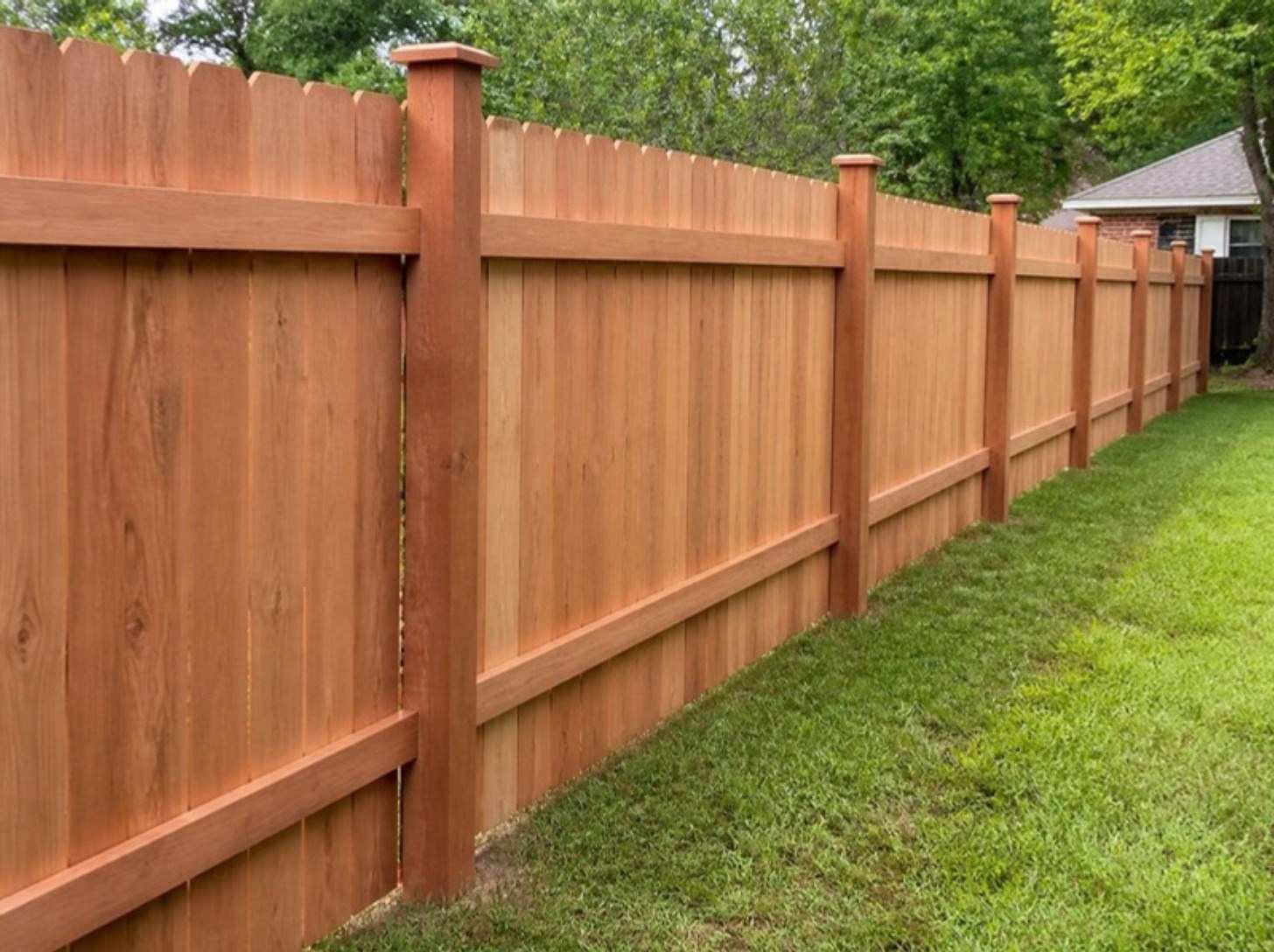
The short answer for a Middle Tennessee yard
If you are weighing a cedar vs pressure treated fence, start here: the boards you see are usually not what fails first. Wood fences often fail at the posts, where they rot or lean at the ground line, rather than at the pickets. Pickets can be replaced a few at a time. That is why many fences here pair pressure treated pine posts and rails with either pine or cedar pickets.
Pressure treated pine usually costs less, and posts made from it resist rot and termites in the ground. The catch is that pine shrinks and twists as it dries. Cedar usually costs more for the same fence. It stays flatter and weighs less, though it is a softer wood and does not last as long buried in the ground. Your budget and your HOA, if you have one, often settle it.
What each wood looks like new and after a few summers
New pressure treated pine often has a green tint from the copper in the preservative, and knots are common in fence grades. Left bare, pine usually weathers to a flat gray, and in strong sun the surface can check, meaning small cracks open along the grain. Stain applied after the wood dries slows that down.
Cedar starts out warmer, and its color can vary quite a bit from one board to the next. Bare cedar weathers to a silver gray, which some homeowners like and some HOAs do not. Knotty grades cost less than clear ones and look more rustic, so ask what grade a bid includes before you compare prices.
The cedar trees growing wild across Middle Tennessee, including in the cedar glades around Lebanon, are eastern red cedar. Many cedar fence boards come from a different tree, western red cedar, which grows in the Pacific Northwest and western Canada. It is fair to ask a fence company which species it is quoting.
How heat and humidity make pine move
Pressure treated lumber is soaked with preservative, so it usually arrives at the job still wet. Over the following weeks and months it dries and shrinks, mostly across its width. A hot Tennessee summer can make that drying fast and uneven. The sunny face of a board dries before the shaded face, so boards may cup or twist. A few pickets pulling loose on a new pine fence is common and easy to fix.
Shrinking shows most on a side by side privacy fence, where the pickets butt against each other. As pine boards narrow, thin gaps open and daylight shows through. Board on board styles overlap the pickets, so the gaps stay hidden. Lumber that is kiln dried after treatment has been dried again at the plant, so it can take a finish right away. It is worth asking about.
Cedar is far more stable. The wood shrinks and swells less than pine as the weather changes, and it is not soaked with water at a treating plant before it reaches your yard. A cedar fence tends to keep its lines from a soggy spring through a dry August, and that stability is a big part of what the extra cost buys.
Rot, termites, and the wet clay under the fence
The two woods resist rot in different ways. Treated pine gets its protection from preservative pushed into the wood at the treating plant. Cedar relies on natural compounds in the heartwood, the darker center of the log. The lighter sapwood near the bark has little resistance, and many cedar boards include some of it. Above ground, where a picket can dry out between rains, both woods do reasonably well.
In the ground it is a different story. Many Middle Tennessee yards have heavy clay that stays wet for days after a storm, and a post in wet clay stays damp right at the ground line. That is where wood fence posts usually rot first. Pine treated for ground contact carries more preservative than above ground lumber and is made for that spot. Cedar posts in wet clay tend to give out sooner.
Subterranean termites live throughout the eastern United States, Tennessee included, and treated pine is made to resist them along with rot. Carpenter bees are a spring nuisance too. They favor bare, weathered softwood such as cedar and pine, so an unstained cedar fence can draw them. Paint deters them best. Stain is less reliable, though it may help a little.
Why the posts matter more than the pickets
A privacy fence is a solid wall that catches wind. When a spring storm pushes on a long run of boards, that load goes straight into the posts. A post weakened by rot at the ground line can snap or lean and pull the sections beside it down too. Pickets rarely cause that kind of failure, and a split one is easy to swap.
So give the posts more thought than the pickets. Ask for pine posts treated for ground contact, and have the crew confirm that rating before the posts go in. Some crews set galvanized steel posts and fasten wood rails and pickets to them, so no wood sits in the ground. Either way, ask how deep the posts will go. If a post has to be cut, brush preservative on the cut end. Deck and building guides call for treating every field cut on treated lumber.
Rock is the other local factor. In many Middle Tennessee yards limestone sits close to the surface, and a post hole can hit it short of the planned depth. A crew may drill into the rock or shift the post, and either choice can change the price. A post that could not go as deep as planned has less room for error, so a rocky yard is a poor place to save money on posts.
Weight, strength, and gates
Treated pine is dense, and fresh from treatment it is heavy with water. Cedar weighs much less, and that shows most on gates. A heavy gate pulls on its hinges and post with every swing, and over time it can sag until the latch no longer lines up. Whatever the wood, a gate needs a braced frame and a hinge post set with extra care.
Pine is the harder wood. Southern pine rates well above western red cedar on the standard hardness test. Cedar dents easily, so a mower bump or a dog pawing at the gate will mark it sooner. Like other softwoods, it can split near the end of a board, where a small pilot hole helps.
Both woods are hard on cheap fasteners. The copper in modern treated lumber corrodes plain steel, and cedar can leave dark streaks around ordinary nails. Hot dipped galvanized or stainless steel fasteners are the usual answer for both, so ask which ones a bid includes.
Staining and upkeep in Tennessee humidity
New pressure treated pine is usually too wet to stain right away, and stain on wet wood may not soak in. The common test is simple. Sprinkle water on a few boards. Water that beads up means wait, and water that soaks in means the fence is ready. Humid weather slows the drying and shaded sections lag behind, so test more than one spot.
Cedar can usually be stained sooner. Its natural extractives can bleed through paint and solid color stains and leave a brownish stain, so an opaque finish needs a stain blocking primer first. A penetrating stain avoids that problem. Before each coat, clean the fence. Our humid summers grow mildew and green algae on shaded sides, often on fences that face north or sit under trees. Go easy with a pressure washer on soft cedar.
Plan on staining again every few years, depending on the product and how much sun each side gets. Some owners let cedar go gray on purpose and only wash it. Bare pine will still stand if the posts are sound, but it tends to crack and roughen faster than stained pine.
HOA rules, permits, and the calls to make first
Many newer subdivisions around Nashville have HOA rules for fences, and some name the material. An HOA might limit you to certain styles or require the finished side to face out. Some also set a stain color every fence has to match. Get the architectural guidelines in writing and submit your plan before any lumber is ordered. Our guide to HOA approval for a deck or fence walks through that process.
Cities and counties set their own fence rules, and they can differ between neighboring towns. Height limits and permit requirements vary, so call the codes office for the city or county where you live and give them your address. Before anyone digs a post hole, call 811 so member utilities can mark their buried lines. The call is free.
How to choose and what to ask on the bid
Pressure treated pine makes sense when budget comes first or when the fence runs along a back line few people see. For privacy from pine, a board on board style hides the gaps that open as it dries. Cedar earns its price where looks matter most, such as the stretch facing your patio. Its lighter weight also helps on wide gates. Many homeowners split the difference with treated posts and cedar pickets.
Whichever way you lean, get both woods priced on the same layout so you compare like with like. The bid should name the species and grade of the pickets and say whether the posts are treated for ground contact. Ask how the crew will handle rock. You can read more on our fence page and see the areas we serve. When you are ready, request an estimate and ask about both woods on the same layout.
Quick answers
Is a cedar fence worth the extra cost in Tennessee?
It depends on where the fence sits and what you want from it. Cedar stays straighter as the seasons change, and it earns its cost on the stretch of fence you see every day. Its lighter weight also helps on a wide gate. Cedar posts usually do not outlast ground contact treated pine in wet clay, so paying more for cedar posts rarely makes sense. On a back line that nobody looks at, treated pine pickets are often the better use of the money.
Can I use cedar posts on a cedar fence?
You can, and some fences are built that way. In Middle Tennessee clay, though, a cedar post stays damp at the ground line for long stretches, and it tends to rot sooner than pine treated for ground contact. Many builders set treated pine or galvanized steel posts even when the rest of the fence is cedar. A matching stain can bring pine posts closer to the color of the cedar boards.
How long should I wait to stain a new pressure treated fence?
Wait until the wood is dry enough to absorb stain. There is no fixed number of weeks, because it depends on the weather and on how wet the lumber was when it went up. Shade slows it down too. Use the water test on several boards. If the water beads, give it more time. Once it soaks in, you can stain. Lumber that was kiln dried after treatment can usually be stained much sooner.