
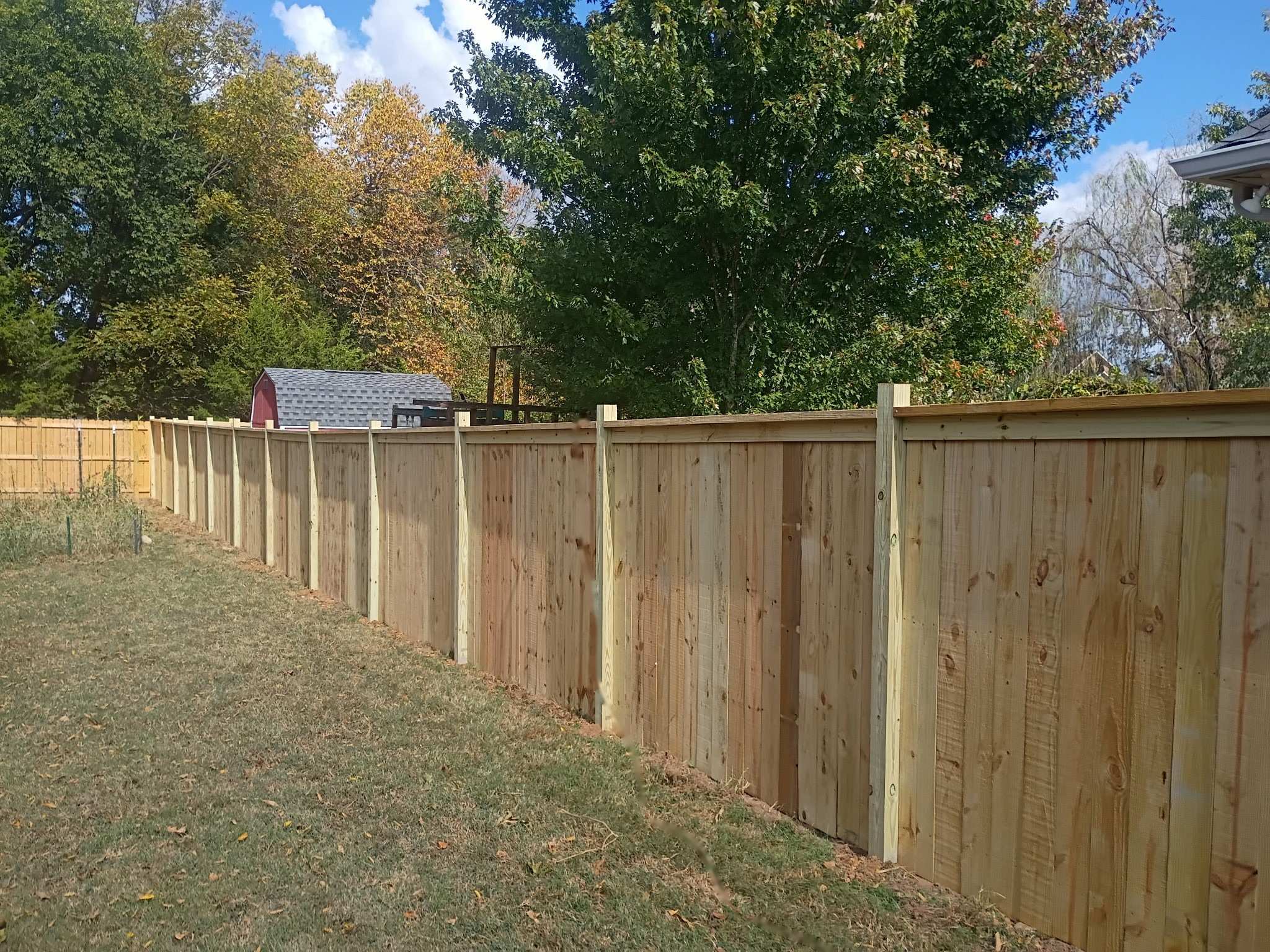
Why fence bids start with a price per foot
Fence companies typically quote by the linear foot, meaning the length of the fence line measured along the ground. A fence repeats itself section after section, with the same posts and rails and the same boards or panels hung on them, so every extra foot adds material and time. That is why the fence cost Middle Tennessee homeowners see on a first bid usually starts as a per foot rate times the length of the run.
The rate is only where the price begins. Gates are typically priced on their own, and corners and ends need extra posts. Short runs tend to cost more per foot than long ones, because loading the truck and setting up take about the same effort either way. On acreage the opposite can happen, with long straight runs across open pasture coming in lower per foot than a small backyard full of corners.
Material sets the base rate
Pressure treated pine is the wood on many privacy fences in Middle Tennessee, and it is usually the lowest cost wood choice. It also moves. Fresh treated pine is usually still wet when it is delivered, and it shrinks as it dries over the following weeks and months. Boards can cup or twist, and gaps can open between pickets that were tight on install day. An overlapping board on board style keeps those gaps covered, though it takes more lumber per foot.
Cedar costs more up front. In return it has some natural rot resistance and tends to stay straighter than pine as it dries, though many cedar fences still sit on pressure treated posts. Vinyl usually costs more than pine and never needs stain. On the shady side of a humid yard it can grow a green film that needs washing, and a falling limb can crack a panel.
Chain link is often the least expensive way to fence a large area, and black coated chain link blends in better than bare metal. Ornamental aluminum shows up around pools and in HOA neighborhoods that want an open look. Neither gives privacy. Our comparison of cedar and pressure treated pine goes deeper on the two woods most homeowners weigh.
Height and style change what goes into every section
A taller fence needs longer posts, and those posts have to go deeper to stay plumb. A solid privacy fence also takes the full push of the wind, and spring storms regularly move through Middle Tennessee. The taller the fence, the more the post setting matters. Height is not fully your call, either. Cities, counties and HOAs may set limits, and front yards may be treated differently from backyards, so confirm what is allowed before you settle on a style.
Style changes the board count. A side by side privacy fence uses the fewest boards. Board on board overlaps them, and shadowbox alternates boards on each side of the rail so both yards see a finished face. A top cap or trim board adds wood and labor at every section. None of that is wasted if you want the look, but it means two bids for a privacy fence can describe very different fences.
Gates are priced as their own small builds
A gate usually costs more than the same width of fence. Gate posts carry something that swings every day, so they are usually heavier and set with more care. The gate itself needs a frame that resists sagging, and hardware such as self closing hinges or a locking latch is a real line item. If the fence surrounds a pool, gates may have to meet specific rules, so check with your codes office before choosing hardware.
Think about what has to pass through. For people and a push mower, a walk gate is enough. A riding mower or a trailer needs a wider gate or a double drive gate, and wide gates need extra bracing to stay square. List every gate you want before you ask for bids. If one company prices two gates and another prices three, the totals will not line up.
Rock and clay under the fence line
Every post goes in a hole, and the ground under that hole is one of the biggest unknowns on many Middle Tennessee fence bids. In many yards, limestone lies just a short way down, especially around Murfreesboro and Lebanon, where cedar glades grow on thin soil over rock. An auger can spin through clay in one hole and stop on a ledge of rock in the next. Getting through it takes heavier tools and more time per post.
Contractors handle rock in different ways, and that choice explains a lot of the gap between bids. Some build a rock allowance into the base price. Others charge extra for each hole that hits rock, which keeps the first number lower but leaves the final bill open. Ask each company which way they do it and get the answer in writing. Neighbors who have fenced their yards may be able to tell you what their crew ran into.
Clay causes a different problem. It stays soggy after heavy rain and shrinks as it dries out in late summer, and that cycle can loosen a post over the years. Many crews set posts in concrete and slope the top so water runs away from the wood. Wood posts should be rated for ground contact. If a bid does not say how the posts are set or how deep they go, ask before you sign.
Slope and the shape of the yard
Rolling lots are common across Middle Tennessee, and a slope adds time to every section. The crew has two basic choices. Racking tilts the rails to follow the ground, which keeps the bottom of the fence close to the dirt. Stepping keeps each section level and drops it at each post, which leaves triangle gaps under the low side that may need filling if you have a dog.
Steep ground can also call for longer posts to keep the top line even. Wet spots at the foot of a hill are worth pointing out, since posts there may sit in wet clay for much of the year. Expect a sloped yard to price higher per foot than a flat one, and read our guide on fencing a sloped yard to see which approach fits your lot.
Tree roots and the old fence
Back property lines often run through a strip of trees and brush. Roots can block a post hole, and cutting a large one can hurt the tree, so a careful crew will shift a post or adjust the spacing instead. Talk that through before work starts. Clearing brush before the fence goes in may be its own line item, and so is hauling the debris away. It also pays to look up. A big dead limb hanging over the line could fall in a storm and flatten a section.
Tearing out an old fence is real work. Old wood posts often sit in concrete plugs that have to be dug out, and new posts usually cannot go back in the same holes. Chain link comes down faster, but its posts are often set in concrete too. Then everything has to be hauled off and dumped. Some bids include tear out and disposal, and others leave it off, which makes the total look lower until you ask.
Property lines and the approvals you may need
Know where your line is before anyone digs. A fence built on the neighbor's side can turn into a dispute, and moving it means paying for much of the work twice. Property corners are commonly marked with iron pins, but pins get buried over the years, and county online maps are only rough guides. When the line is unclear, a land surveyor can mark it. Our guide on fences and property lines in Tennessee explains the options.
Permit rules for fences vary from one city and county to the next, and corner lots may carry extra limits so drivers can see past the fence. Call the city or county codes office with your address before you sign a contract. In newer subdivisions around places like Spring Hill and Mount Juliet, an HOA may set rules on style and height and often wants the finished side facing out, so get approval in writing first. Whoever digs the post holes should also contact Tennessee 811 so the member utilities can mark their buried lines. Lines the homeowner owns, like power run to a shed, are not marked. These steps may never appear on the fence bid, but they are part of the real cost.
How to compare fence bids line by line
Two bids with far apart totals may not be pricing the same fence. Start by checking that each one names the same length and height. Then compare what the fence is made of, down to the lumber grade and the post material, and how the posts are set. If a bid leaves something out, ask. A vague answer now tends to become a change order later.
Next, look for what low bids often skip. Tear out and hauling are common gaps, and so is the plan for rock. Check whether cleanup is included and whether stain is part of the job. New pressure treated pine usually needs time to dry before it takes stain well, so staining may come as a later visit. Ask how long the price holds, since lumber costs move.
The lowest number is not always the cheapest fence. A bid that skips rock or removal can grow once work starts, and posts set too shallow can lean long before the boards wear out. When you are ready to price your own yard, start on our fence page and check whether we work in your part of Middle Tennessee.
Quick answers
Why do fence quotes vary so much for the same yard?
Usually because the bids describe different jobs. One may include tearing out the old fence while another leaves it off. Rock is handled differently too. Some companies build an allowance into the price, and others charge for each hole that hits rock. Lumber grade and post spacing can also differ. Match every line before you compare totals, and ask for details in writing when a bid is vague.
Do I need a survey before I build a fence?
Not always, but it is the safest route when you are unsure where the line is. If you can find your property pins and they match the plat in your closing papers, some homeowners go ahead without a new survey. When pins are missing or a neighbor sees the line differently, a survey is usually worth paying for. Some HOAs also ask for a drawing that shows the fence on the lot.
Can I save money by taking out the old fence myself?
Often, if you have the time and a way to haul it off. Pulling boards and rails is simple work. Old posts are the hard part, since many are set in concrete that has to be dug out. Ask the fence company first whether they want the posts removed or cut flush with the ground, and make sure removal is not already bundled into the bid so you do not pay for it twice.