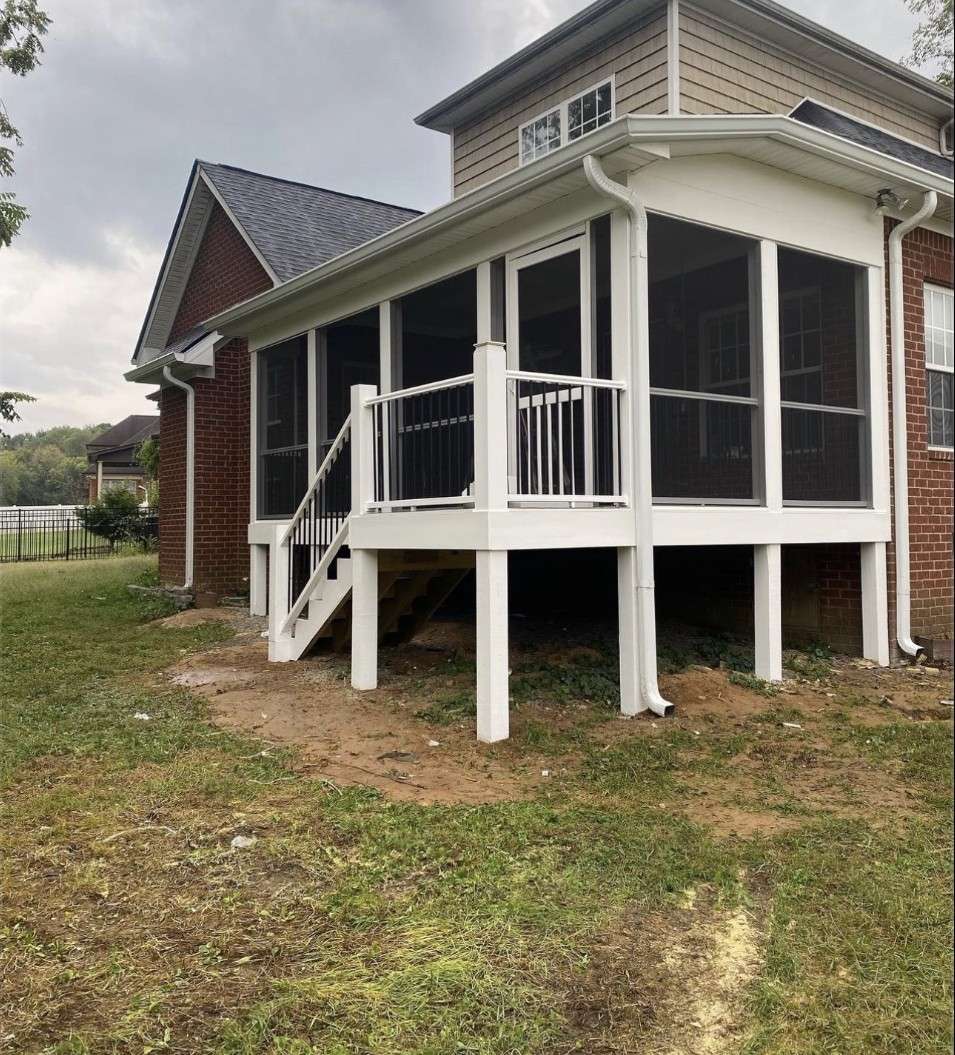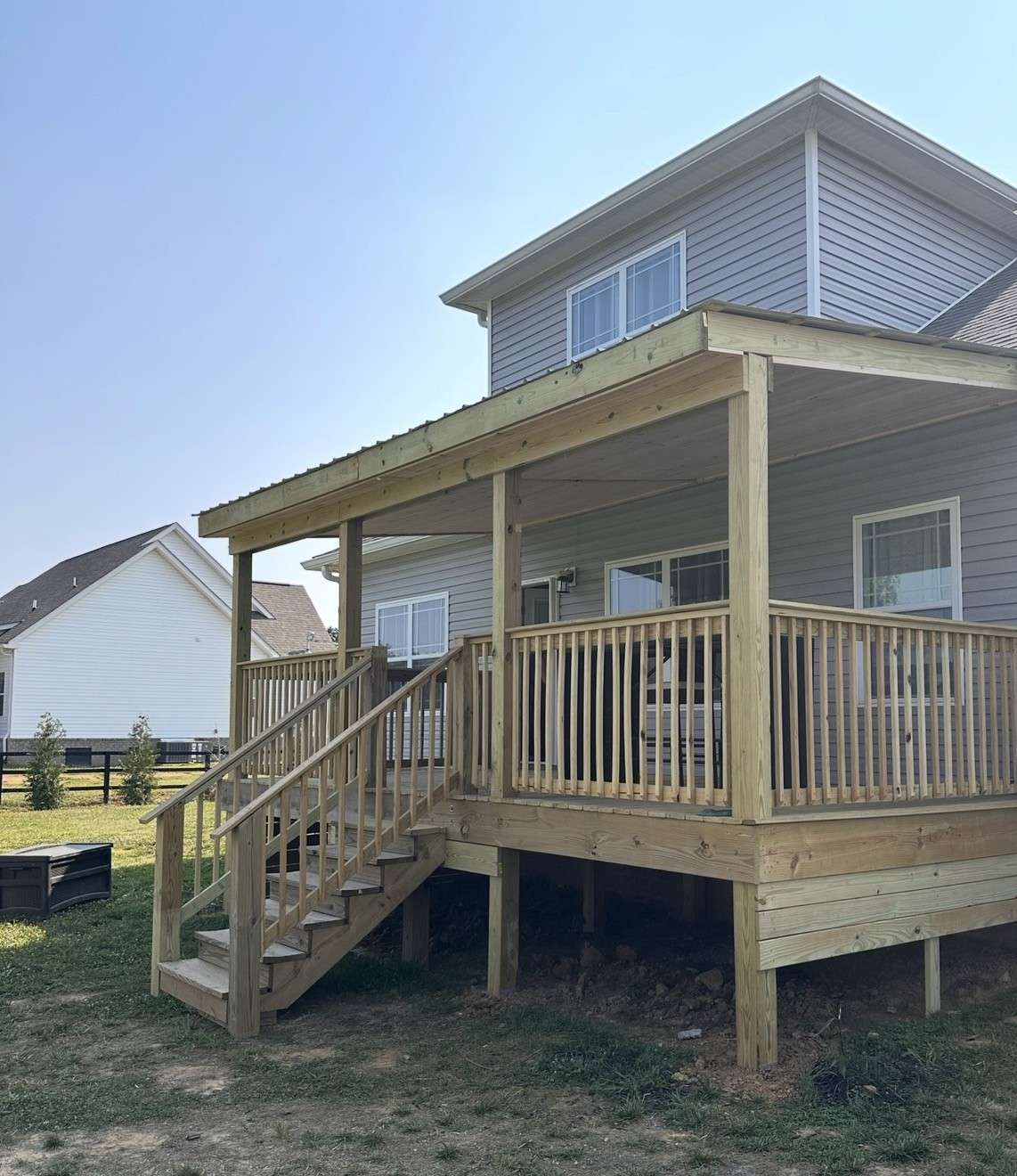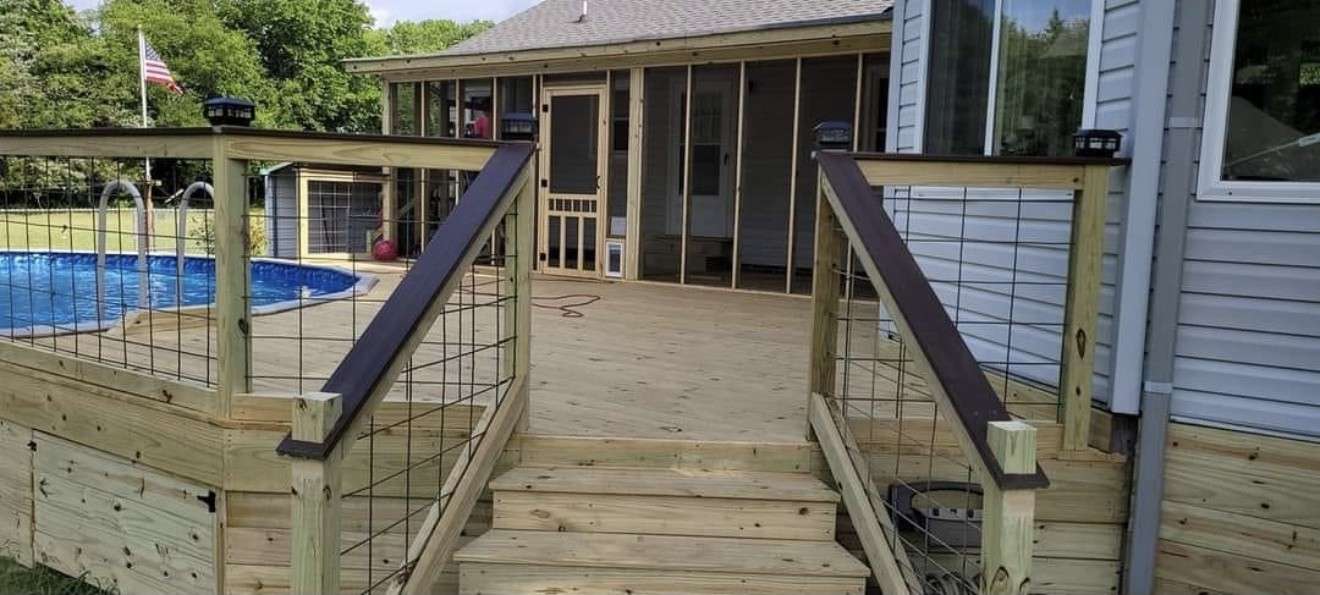
Tall decks on Smithville lake lots
Height is what sets Smithville lake decks apart. When the main floor sits well above the slope, every post is long, and long posts need bracing so the deck does not sway when a crowd moves across it. The connection to the house matters just as much. A tall deck puts more strain on its ledger board than a low one, so the ledger has to be fastened into solid framing with the right hardware and flashed so water cannot get behind it. None of that is visible once the boards are down, which is why it is worth asking about.
Stairs are the other big piece. On a steep lot near Smithville, the run from the deck to the yard can be long, and it often needs a landing partway down. Where the stairs end matters as much as how they start. A bottom step on soft soil that washes out in a hard rain will settle and pull the stringers out of line. Plan for it to land on firm ground or a small pad.
Footings in rocky Smithville ground
In many spots around Smithville, limestone sits close to the surface, and on steep hillsides the soil is often thin. A post hole that hits rock partway down cannot always be dug deeper with ordinary tools. Sometimes the rock can serve as the base, if the inspector agrees. Other times the footing has to shift over or change shape. Depending on where you live, the codes office may want to see footings before they are covered. When you compare deck builders around Smithville, ask each one how they handle rock. Call Tennessee 811 before any digging so buried utility lines get marked.
Where your land ends at Center Hill Lake
The Corps of Engineers manages Center Hill Lake, and on many lots the land nearest the water belongs to the Corps, not to the homeowner. Private structures there generally need Corps permission, so plan on keeping the deck on your side of that line. That sounds simple until you want stairs that reach toward the water or a lower platform partway down the hill. Before you design either one, find your line on a survey and ask the Corps office that manages the lake what it allows on its side.
Trees are the other catch. Plenty of Smithville lake owners want a clearer view from the deck, and the trees in the way are sometimes on Corps land. Cutting or trimming there is up to the Corps, not you. On your own land, check any HOA rules first, and think twice before removing healthy trees on a steep slope. Their roots help hold the hillside in place, and a bare slope under a deck can start to wash.
Railings that keep the lake in view
On a tall deck, the railing sits right in your line of sight when you look out at the water. Wood balusters are sturdy and usually cost less, but they block more of the view. Metal balusters and cable rail are easier to see through. Whatever you choose, the railing should meet whatever guard rules your codes office enforces for height and opening size, and on a tall deck it has to hold up to people leaning on it. Ask any Smithville deck builder you talk with how the railing posts are fastened to the framing, not just how the railing looks.
Using the space under a high deck
A tall deck leaves a lot of room underneath, and on a wooded lake lot outside Smithville that space is often shaded most of the day. Some owners want a patio there. Others want a dry place to keep kayaks and life jackets. Either way, water is the problem to solve. Rain falls through the gaps between boards, and on a slope it also runs downhill under the deck. If you plan to use that space, say so early, because it changes how the deck is built and where the water goes. You can note it on the estimate form.
Town decks and weekend houses in Smithville
Closer to Downtown Smithville, most decks are low platforms off a back door. They are simpler to build, but older houses bring their own questions. The siding may need to come off where the ledger goes, and the door threshold may sit at a height that makes the step out awkward. Check the band board behind the siding for rot before anything is attached to it. On a low deck, airflow under the framing matters too, since damp ground with little air moving is hard on wood.
Some lake houses around Smithville are weekend places or rentals. When you are not there every week, low upkeep counts for more, and the railings and stairs have to stand up to guests who do not know the house. Composite boards usually cost more at the start but skip the regular staining that wood needs. Under heavy tree cover, both still need cleaning to keep mildew off. Our guide to wood vs composite decking lays out the tradeoffs.
Smithville deck questions
Do I need a permit to build a deck in Smithville?
A raised deck attached to the house needs a permit in most places, but who issues it depends on where the house sits. Inside the Smithville city limits, start with the city. Many lake homes are in unincorporated DeKalb County, so the county is the place to ask for those. Requirements can differ between the two, so confirm before work starts. HOA approval, if you have an HOA, is a separate step.
Is there a limit to how tall a deck on a lake lot can be?
There is no single answer. Your codes office sets the rules for your address, and a very tall deck may need drawings from an engineer before a permit is issued. What is certain is that height changes the build. The taller the deck, the heavier the posts and bracing need to be, and the longer the stairs get. If your main floor sits high above the slope near Smithville, mention it when you ask for a price.
What if a truck can't get close to where the deck goes?
That is common on lake lots near Smithville. Lumber and concrete may have to be carried down a slope by hand or moved in small loads, which adds labor. Tell us about access up front, including steep gravel drives and spots where a trailer cannot turn around. Access is one of the bigger reasons two decks of the same size can come in at very different prices.
How do I know if the old deck on our lake house is safe?
Start where the deck meets the house. Rot at the ledger, loose or rusted fasteners, and posts sitting in wet soil are the warning signs that matter most on a tall deck. Soft boards and wobbly railings are easier to spot. If the deck bounces or sways when people walk across it, have it checked before the next busy weekend. Our guide on signs you need a new deck walks through what to look for.
Can a lower landing or second level be added on a hillside?
Often, yes, as long as everything stays on your land. A lower landing partway down the hill breaks up a long stair run and gives you a second place to sit. Anything that reaches toward the water runs into the Corps line on many lots, so check the survey first. Slope and rock both change what a second level costs, so it is usually cheaper to plan it with the main deck than to add it years later.